Sunday, 2 November 2014

2014 batch 2: Currant mead (5) - Addition of currant juice

In the afternoon Saturday the 1st of November I took out the currant juice from the freezer. The juice was prepared this summer as described HERE. It is the steamed juice of red currant and black currant from the  ribes bushes in our garden. The volume is about 3.5 L and consist of approximately 1.25 L of red currant juice, and 2.25 L of black currant juice

Sunday the 2nd of November
In the morning I checked that the juice had thawed and the temperature was just below room temperature. I emptied the juice into a clean fermenter and then I just racked the batch onto it, stirred a bit, and closed it up. After the addition SG was 1.011 so there was plenty of sugar in. Secondly the total volume is now 23 L, so assuming that I was at about 15% ABV at the time of racking, I am now at 13%. Further more, if 1% ABV is generated from a gravity change of 0.00753, then the mead can potentially convert a gravity of 1.015 to 1.000, i.e. I am a bit short in sugar - 0.004 gravity units

So if 7.2 kg gives a gravity of 1.120 then I am 240 g of honey short. So I added 300g (actually 295g) which should add about 0.005 to the gravity.

About 5 hours later I measured gravity and pH again
SG: 1.011
pH: 3.41
Temp: 24.7 C

I noticed that pH dropped significantly when adding the juice - from 3.7 to 3.4. Also the mead is now foaming quite a bit so there was plenty of proteins in the juice also. I am not sure this was a good thing. If the fermentation stops completely, some not so pleasant compounds might be present due to partially degraded protein. Well, now I will just have to see if the fermentation will run for at least 24-48 hours more and then stop before the batch runs out of sugar :o).
______________

In all calculations I do not take into account that ethanol lowers the density of the solution. All measurements are with quite large uncertainty anyways, so adjusting for ethanol content by extensive calculations just seems like overkill. 

2014 batch 2: Currant mead (4) - fermentation is ending after just week :o)

I continued to monitor the gravity, pH and temperature after the last addition. All measurement were done in the evening so that the intervals between measurements were as close to 24 hour as possible

Thursday the 30th of October
Sg: 1.040
pH: 3.69
Temp: 23.6 C

Friday the 31th of October
Sg: 1.022
pH: 3.68
Temp: N.A.

Saturday the 1st of November
Sg: 1.010
pH: 3.70
Temp: 22.7 C

So how does this SNA batch compare with the cyser. When plotting the gravity readings you get


I called it Sack as the currant juice has not been added yet, so as of now it is produced as a Sack mead. It is very clear what with Staggered Nutrition Addition you get a very fast and consistent fermentation (almost linear progress), which is at the end after 6-7 days :o)

Basically I had estimated that that a drop of 0.100 would correspond to 14 %. Hence if the yeast max out at 15%, it should not change gravity by more than 0.107 and should in this case have stopped at 1.013. Now it is 1.010 and it is still going strong even though the rate has been reduced a bit

The simple formula for calculating Alcohol by volume is:
ABV= (OG-FG)/0.00753 (ref wikipedia)
This basically says that the gravity changes by 0.00753, then 1% of alcohol is produced.

For high gravity there is a somewhat more complicated formula.
ABV =76.08*(OG-FG)/(1.775-OG)*FG/0.794
The idea is that more ethanol is produced at the end of the fermentation since the replication rate reduces. This means that more alcohol should be produces per gravity unit.

The high gravity formula (alternative formula) as it is returns ridiculously high ABV values - far higher than the yeast max, so I just adjusted the simple formula by using a factor of 0.0071. So 15%max x 0.0071 = 0.107.

Right now I am back to the original simple formula. Then, for an ABV of 15% the new low is 1.007 instead of 1.013.

Friday, 31 October 2014

pH meters - which one to buy

I have been looking at several blogs to see which pH meters were used by home brewers. It is a fantastic tool, but can also be quite expensive. Never the less I recommend that everyone with an interest in the details of how your wine, mead or beer develops to purchase a proper pH meter. But as always it is important to look around before you buy.

I came across 5 different brands with pH meters with products that could be used for home brewing. These were

Hanna Instruments
Milwaukee Instruments
Adwa Instruments
HM Digital and
Atago

Other brands are available on the web but as far as I know these are not available from danish suppliers. These are:
Omega (PHH-7011)
Hach (H series H160 or H170)
LaMotte (Tracer Pocket Tester)
.... (Let me know which ones I missed) ....


Hanna-, Milwaukee-, and Adwa- Instruments
Researching the web I made an interesting observation. Hanna, Milwaukee, and Adwa are very likely the same company. They all have office at EXACTLY the same address in Hungary. 
...Alsókiköto sor 11., H-6726 Szeged....
So if prices for these 3 brands are similar, it is not a surprise.  

It bothers me quite a bit that one company are giving the customer a sense of choice by producing different brand names but are in fact selling the same "crap in different wrapping".

So the choice was now down to HM Digital and Atago. 

HM digital
HM is a US company and their pH meters are produced in South Korea. They sell 2 different pH meters that are useful for home brewers:
pH 80 and
pH 200
The main difference is the resolution. pH 80 show results with one decimal and pH 200 with 2 decimals. 

Atago
Atago is a japaneese brand and sells only one pH meter - the DPH-2. This pH meter only has a resolution of 1 decimal. 

The Choice...
Hereafter it was quite easy for me to choose, and I purchased the pH 200 from HM Digital. As a bonus it was also cheaper than the "Hungarian Huddle" 


I will try it out for a while before reviewing it. As for now, it is fulfilling all expectations. 


Thursday, 30 October 2014

2014 batch 2: Currant mead (3) - Fermentation progress

I have spend several days monitoring how the fermentation has progressed:

Monday the 27th of October
The following day I opened the fermenter and sampled for gravity and pH.

pH: 3.84
SG: 1.110
Temp: NA

Bugger, I forgot to measure temperature (?). Never the less it is interesting to see that pH had fallen from 4.7 to 3.8 due to the CO2 produced by the yeast. This is still in the start-up of the fermentation so yeast count is probably increasing. The resulting SG shows a decrease in gravity of 0.010.

Then I added the second nutrient pack:
Fermaid K: 2.0 g
MAP: 4.0 g
MAC: 3.0 g
K2CO3: 2.0g
Total: 64 ppm N and 57 ppm K+

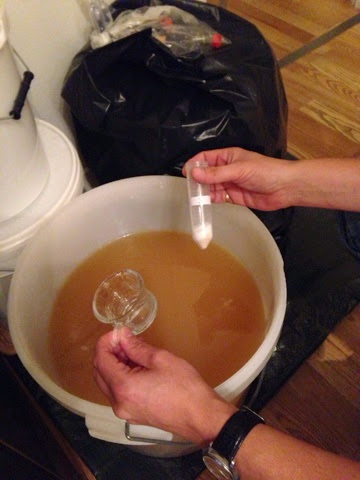
I poured about 30 ml of must into the tube containing the nutrients, swirled it a bit to make a slurry and poured the content into the fermenter. To my surprise the must started to foam very aggressively, and I started to worry that I would be cleaning the floor for sticky honey. Fortunately, the foam stopped a bit before the edge. Then I stirred the must quickly to dissolve the nutrients, closed the fermenter and re-attached the airlock.

Evening Tuesday the 28th of October

pH: 3.64
SG: 1.088
Temp: 25.7 C (?)

So pH had droåped even further. Even though I add carbonate with both MAC and K2CO3 it might push pH a bit but it will fall again at least within one day. SG was surprisingly low. Gravity had fallen 0.022 in just one day - that is about 1/5 of the sugar available for fermentation, i.e. at this rate the fermentation could be over in just 5 days, WOW. Temperature was high, but I am not sure I trust the reading. The room was 23 C so the fermentation should have raised the temperature by almost 3 C - seems like a lot.


I then added the 3rd nutrient pack which was identical to the second one above. This time I did an effort to slowly dissolve some of the additives, pour it in, add more must to tube, dissolved a bit and pour it in, etc.
Never the less I still got a lot of foam.


Evening Wednesday the 29th of October

pH 3.63
SG 1.066
Temp: 24.1 C

It seams like pH has leveled out despite addition of carbonate so the must is probably now well buffered by bicarbonate. Once again SG had dropped 0.022 which I am still surprised about. Temperature is now within the expected range just a bit above room temperature - great

The 4th nutrient pack was added with was also identical to the second. Even though I planned for 5 nutrient packs I will not be adding the 5th. Since OG was 1.120 and I expect a FG to be 1.013 for an ABV of 15 % or a drop of 0.107 then an SG of 1.066 corresponds to 50% of the fermentation progress. Most articles says that you should not add nutrients past this point, so I will stop here and see what happens.
_________________

The 5th nutrient was a bit smaller than the previous packs

Ferment K: 1.0g
MAP: 4.0 g
MAC: 3.0 g
K2CO3: 2.0 g
Total: 57 ppm N and 57 ppm K+

My plan was to add 300 ppm N and 255 ppm K+. As it turned out I will have added only about 240 ppm N and 200 ppm K+.

In the coming days i will continue to monitor SG and pH. If the rate continues the fermentation should finished by Saturday - that would be a new record for me :o). And I will use this SNA scheme with 4 additions in the future.


2014 batch 2: Currant mead (2) - Fermentation start

Recipe:

7200 g of Summer honey, 2014
140 g of Spring honey, 2014
5 Nutrient packs according to SNA scheme
Water to 20 L
3.5 L of currant juice

Starter:
As always I am aiming at a starting gravity of 1.120 which is so high that it could become difficult for the yeast to really get started - So just in case I initiated the fermentation with a starter at a little less than half the gravity.

I dissolved 140 g of "spring honey" in 800 ml warm water, covered the glass and let it cool to room temperature. 

pH: 5.98
SG: 1.058

Just before adding the yeast I whipped the solution with with a kitchen mixer to get as much air into the solution as possible. Then I added the yeast which again was White labs, Sweet Mead, WLP715, covered the opening of the glass and placed it on my home made magnetic stirrer. The solution was stirred once in a while to ensure good mixing. 

The starter was up and running Saturtday the 25th of October at noon

Mead fermentation:
In the evening of the 25th of I prepared the must.

All the honey (7.2 kg) was poured into a fermentor. I just left the honey container up-side down for a while to get as much honey out as possible. Then I heated 10 L of water to 70oC and poured in into the fermenter too. Some of the water was used to rinse the honey container to ensure that I got it all out. I started to stirr to dissolve the honey. When no more honey was sticking to the bottom of the fermentor I added about 5 L of cold tap water so that the total volume was just below 20 L and stirred the solution well again. Then I left it overnight to cool down. Following this procedure the solution was 40 C when I finished.

Sunday the 26th of October:
During the day I was checking the starter. It was quite clear that the fermentation was running. When not stirring I could see plenty of small bubbles making the surface almost vibrate.

In the evening I added Nutrition pack 1 to the mead:
Fermaid K: 3.0 g
MAP: 3.0 g
MAC: 1.0 g
K2CO3: 1.0g
Total: 47 ppm N and 28 ppm K+


I left the solution for a couple of hours and measured

pH: 4.66
OG 1.120
Temp: 23.0 C

Notice that just honey and water gives pH around 6 whereas pH is 4.7 when nutrients are added. This means that the buffer capacity of the honey is almost non-existent. OG was on the target :o)


The starter was added and the beaker was rinsed with about 2 dl of water. So the total volume was just above 20 L. Finally the lid was closed and the airlock was filled with water and placed securely in the lid. Time to wait for the first bubbles from the airlock


Monday, 27 October 2014

2014 batch 2: Currant mead - SNA scheme (JPEG)

I could not figure out how to attach a file to the blog, so I just scanned the SNA scheme that I prepared.

It look like this:

For some reason, the last line of the page is not scanned - that is what you get when you buy a cheap printer/scanner. 

Everything is calculated once you entered the weighed amounts. The scheme is set up for additions over 5 days but will be adjusted according to how this mead behaves. 

Sunday, 26 October 2014

2014 batch 2: Currant mead - SNA preparations

This time I will try to make a currant mead using the current juice I prepared this summer and have been storing in the freezer since (ref. HERE).

Secondly, I will try to keep the fermentation strong until the max ABV is reached by Staggered Nutrition Addition.

Basically there is not much else but glucose and fructose in the must. This means that if nutrients need to be added to avoid a sluggish fermentation. As far as I can find on the internet I need:
300 ppm of FAN/YAN
300 ppm of potassium.
and yeast nutrients in general.

For this I used Fermaid K and since I still have not been able to get DAP, I am using a mixture of monoammonium dihydrogen phosphate (or MAP) and monoammonium bicarbonate (MAC). MAC can also be purchased as the baking spice "Hartshorn" but be sure whether you purchase ammonium carbonate or ammonium bicarbonate. It appears that both are sold under the same name. Furthermore, DAP or MAC/MAP should not be added in high concentrations as it then becomes toxic to the yeast. The idea is to spread out the additions over several days and keep the concentrations at a consistent level for the major part of the fermentation.

As potassium source I used pot ash or potassium carbonate. This is also a quite basic compound so I decided to add it in a staggered fashion too so pH is not to high in the beginning and use it to raise pH a bit during the fermentation so that CO2 does not push pH too low. I cannot measure the content but based on the figures I can find on the web a general honey should contain about 200 ppm K+. In 20 L must that I intend to prepare the concentration becomes 53 ppm. Hence, I just need about 250 ppm to reach the 300 ppm needed.

I prepared a quite extensive spread sheet but in short the additions are as follows

day 1: 47 ppm N and 28 ppm K+
day 2: 64 ppm N and 57 ppm K+
day 3: 64 ppm N and 57 ppm K+
day 4: 64 ppm N and 57 ppm K+
day 5: 57 ppm N and 57 ppm K+
Total: ~300 ppm N and ~250 ppm K+

Or put in another way:

Total Fermaid K: 10g
Total MAP: 19 g
Total MAC: 13 g
Total pot ash: 9 g
i.e. total additions: 51 g

Everything added each day was weighed into 5 tubes (various amounts of Fermaid K, MAP, and MAC) and the tubes were labeled 1-5 so that it would be easy just to add one tube every day for 5 days


Finally I also prepared for an 800 ml starter with 33 ppm of N from Fermaid K only. Now I am ready to go.

I wonder if it is possible to add an Excel sheet to this blog for easy access...... Anyone?