Tuesday, 30 September 2014

The last honey harvest - so which honeys to use for mead

By the end of August i harvested 3rd and last time this year. The honey yield has been quite OK. First harvest resulted in 22.8 kg, second harvest 21.9 kg and finally third and last was 11.0 kg - a total of 55.7 kg from just one hive. Not bad! 2014 has been a good year.

I had bought a 20 L bucket instead of the 40 L which I have used  earlier since I try to collect several times during the summer and I will never have more than 25 kg after harvesting one magasin, which corresponds to 18-19 L. It is also more handy in small kitchens :o)

Below the third honey batch is transferred to the final container.

I reserved 7.4 kg of honey from the spring honey as described earlier and 2 x 7.2 kg from the summer honey so a total of almost 22 kg. The rest we are enjoying or selling - first come first served. This is all that is left from the first two batches ...


The mead I prepared last year has a strong acidic note to it, which can be directly traced to the honey used, but there was only one batch to choose from. This year I have selected the more smooth batches - spring and summer. The late summer batch has a strong sting to it so now I am wondering what the source is, so that I next year can harvest before this flower bloomes. The summer honey (clover and flowers) is just fantastic and the spring honey (fruit trees and early flowers) is a close second. The late summer honey is not fit for mead making in my opinion, but it is still great for eating, salald dressing, glacing etc. Mmmmmm. I will probably stir it untill it crystallizes as this should take some of the acidic sting out too.

Monday, 29 September 2014

2014 batch 1: Cyser

Finally back in the apartment, so now I have time to write again :o)

This weekend I have prepared a second cyser. I hope that I can repeat the success from last year because that mead is just fantastic.

At first I needed apple juice. I have been collecting apples throughout September so that I would have enough for 20 L. This year the season is over already, so I have been storing apples in airtight boxes hoping that they were not all rotten when I got access to the apple press.

Most of the afternoon Saturday I was crushing and pressing apples with some help from a friend. In the end I had about 16 L so I went to the local store to pick up some apples (fortunately they were on sale) - 12 kg of danish aroma apples which turned into about 6 L.

Slicing......
Crushing...
And pressing...

I finally got 20 L for the cyser which roughly were distributed:
Red Ingrid Marie: 7 L
Guldborg: 5 L
Aroma: 5 L
Pigeon, Ananas, and "unknown": 3 L

The rest of the juice will be enjoyed over the next few days. 

So the recipe was as follows:
20 L of apple juice
5.5 kg of summer honey
12 g of pectonase
Sweet mead/wine yeast (WLP720)


In the evening I prepared the must by raising the temperature of the must to 80C for 10 min to knock out wild yeast. Since I only have one 12 L pot I had to heat 10 L at a time.


Last year I used 7.2 L of honey and the gravity was out of the scale. Best estimates OG was about 1.170 so it was probably close to dumb luck that the fermentation started at all.

This year I wanted to take into account the sugar content of the apples (yes that was what I did not do last year....). I measured the gravity of the warm must to about 1.035@60C, so at 20C the gravity is probably closer to 1.040 so if I want to start at 1.120, I need to add about 0,080 in honey. Last year I got an increase in gravity of about 0.016 for 1 kg of honey when the total volume was 20L, so that would be 0.080/0.016= 5 kg. Now adding honey will increase the volume and I will also loose water during the boiling, so I estimated my total volume to 22 L so all in all I would need 5 kg /20L*22L =5.5 kg. Then OG should be around 1.120.

Yeast starter: On the yeast bottle it says that a 1-2 pint starter should be considered if OG is higher than 1.070. So I diluted 300 ml of must with 300 ml of boiled (and cooled) water. The gravity was measured to about 1.058. The yeast was heated to room temperature for 3 hours and then added to diluted must. I used a magnetic stirrer to agitate the solution so I would continuously aerate the solution. Then I left the starter over night so that I could add it the next day in the evening, when the must had cooled.


Sunday morning the must had cooled to 28C so I added 12g of pectonase. I would now have the entire day to work on the must.

Well, things initially looked good with the starter but then suddenly at around noon I find the the stirrer was overheating and the started had been heated to 35C. I did not have anything nice to say by then. Fortunately I have several yeasts in the fridge, so I could quickly begin preparing a second starter using the same volumes as before. This time I used my home made magnetic stirrer (instructions on how to do that later). Secondly I aerated the starter solution with a kitchen mixer to speed up the process. The yeast was taken out of the fridge at 14:30. At 17:00 the starter was prepared and it was added to the must at 23:00. Not must time to become a starter............

Second attempt at a starter. Notice there are two yeast flasks to the right. Aerate...

...then stirring...

The OG of the must was 1.116 (as could be expected from the gravity of the starter...) I also measured pH with my new purchased pH meter - no more pH strips :o). The must was 3.21 whereas the starter was 3.40 so I guess the CO2 generated by the yeast lifted pH a bit. Usually pH is high in the must and is then lowered by CO2 generation.

The must was aerated by stirring it roughly with a large spoon for a few minutes and then the starter was added. Now it is just time to wait and see when the happy bubbling will start.

Monday morning: The water level in the airlock had not moved at all... But then started slowly to move ..... And made the first plop just before I went to work. Jaaah. Is there a better way to start the day ;)

Monday, 4 August 2014

Currants for mead

In our garden we have a few currant bushes. One red currant and three black currant. The yeald from these bushes are quite big so once we had our share of fresh berries I "confiscated" the rest for mead making. Several hours of picking later I had about 1.7 kg og red currant ...


and about 3 kg of black currant. I figured I would mix the berries so I get the sweetness of the black currant and the acidity og the red currant.

Since I will not start up any mead making untill the fall, I decided to juice the berries and then freeze the juice. For that purpose I used my trusted juicer. The advantage is that the juice is not boiled but the berries are heated untill they bust and the juice is extracted with water vapor. When no more juice can be extracted the the only very little water is collected so you do not risk diluting the juice if you leave the juicer a little too long on the heat. I also enjoy that it is such a clean procedure and it easy to keep contaminations out.


The flasks used for collecting the juice just cleaned in boiling water and I did not add anything to preserve the juice. And oops, there went another glass of last years cyser - busted :)

In the end I had about 1.25L of red current juice and 2.25L of black currant juice. 

The plan is to start out with about 20L in the primary and then add the juice in the secondary. The volume should then be about 23L (20 - 0.5 for racking + 3.5L of juice) i.e the juice will constitute about 15% of the total volume. To get an idea of the taste I mixed 15 ml to 100 ml of water. The color was OK and the taste was there, though kind of light. I do not think think the juice will overpower the taste of the mead/residual honey. The smell of the berries is quite strong thoughand it will give an interesting nose to the mead

The juices were pooled in a 5L plastic container and stored in freezer. I am already beginning to look forward to the fall;)

And what do you make with fresh berries? .... Cake of cause! 


Tuesday, 29 July 2014

Water content of the honey

I purchased a refractometer to measure the water content of the honey (RHB-90ATC). It is a cheap instrument and it is not that easy to calibrate. Never the less I got it done so that I was satisfied. I measured just 15% water in the honey which is just great - far from the critical level of 20%. If the water content becomes higher there is a significant risk of contamination of microbiologic organisms


Just for comparison I measured the water content og a commercial product. It was 19%. This also give me some certainty that the calibration is OK, since I would expect a commercial product to be as high in water content as possible so that there is more to sell from the same batch of honey. 

All I can say is "Buy honey from your local bee keeper and get more honey and less water!! "

Honey for mead - but how much

To put honey aside for a mead I need to figure out how much I need. I have been looking for another yeast that gives a bit less alcohol and I found a mead yeast capable of 15% given the best conditions   (White Labs WLP-720)


Last year my yeast maxed out at 16% and changed the gravity by about 115. Ken Schramm specifies a gravity change og about 100 for a 14% yeast, i.e 1% per 7(+) gravity change.

7.2 kg to 20L gave a OG of 120. If i want the mead to be a bit sweet I want FG to be around 20, so with a 15% yeast I need an OG of 20+100+7 = 127. Assuming that the water content was like last year I need to start with 7.2kg / 120 * 127 = 7.6kg

So 7.6 kg was collected in a 10L container. When used, i just need to wash the entire content into the pot. The container can easily be washed on the outside before I make the mead so i can just pour water back and forth to ensure that the entire mass of honey is dissolved

This will be the base mead. I will likely end up making melomels so now is the time to select berries...

Cleaning the surface of the harvested honey

I left the barrel with honey  for a few days so that bubbles and wax particles could rise to the surface. With a bit of patience the bulk honey becomes quite clear and the surface then looks like this


I was actually quite surpriced how easy it is to clean the surface. Just cut a peace of parchment paper (the stuff used for wrapping in lunch boxes) in a circle just a bit larger than the surface. Lay the paper on the surface, so that the entire surface is covered an pad it where smal air bubbles are trapped. Let it sit for a short while. 

Remove the parchment paper slowly by pulling it off from the edge. The process can be repeated if neccessary but it "costs" about 200 g of honey. For me once was just fine.


Final yield: 22.8 kg for one magasine with 10 plates (12x10)  :o). Hope I can do that again later this year.

I plan to use part of the honey for one batch of mead, take enough for excessive house hold use and then sell the rest as early summer honey.

Tuesday, 15 July 2014

First honey harvest

Long time since my last post. Living in the garden house without internet makes it a bit expensive to use the phone...

Never the less I could hardly lift the first honey compartment mid june, so then it was time. Some friends helped out which made it a very enjoyable day

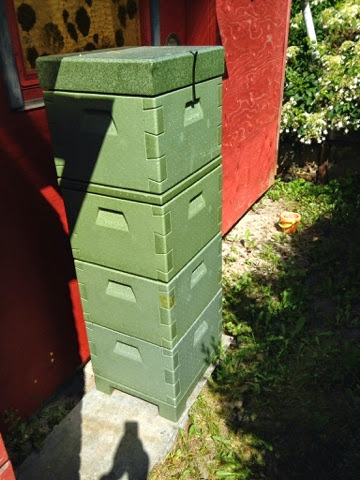
A week prior to the harvesting day I had inserted a plate with a one way passage to empty the magasine to be harvested for bees. It is the narrow plate between the two top magasins in the pic below


At the day of harvesting there was only about 100 bees in the magasin, compared to the typical 10000 to 15000 usually in there.


My little helper an I dressed up and got started


Almost completely sealed plates - all 10 of them. Then the lid on each cell was scraped off, an the plates was then placed in the sling, 2 at a time


The honey passes through a sieve inside the sling and is then collected in a bucket.


The bucket is then emptied into another sieve into the final barrel.


A very simple process, and the smell in the kitchen was just fantastic. So great that the extensive cleaning afterwards is all worth while :)

All in all we collected 23 kg from just one magasine (12x10) - EXCELLENT!  8 kg for one batch og mead has of cause already been set aside.

This is my early summer honey. I expect to harvest once again in July and possibly also in August